Summary
I discovered a critical Insecure Direct Object Reference (IDOR) issue in the NYC.gov appointment scheduling flow for NYCID.
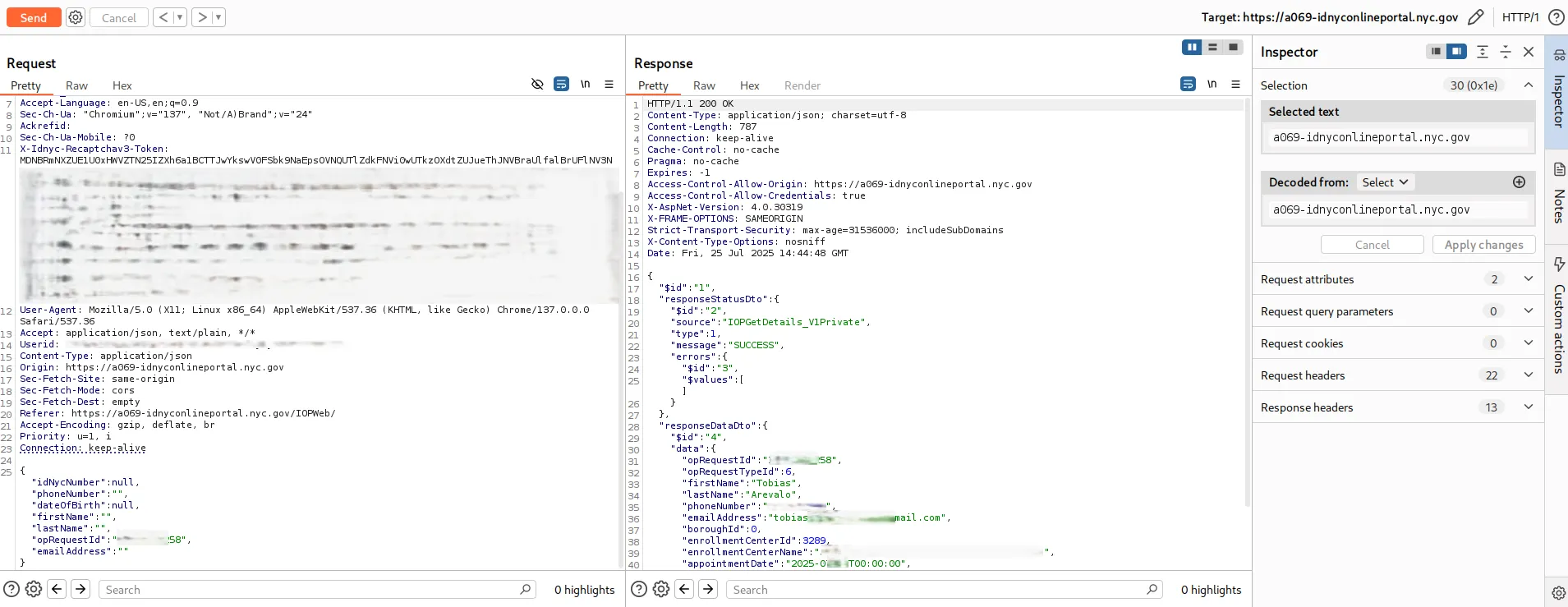
The application allowed anyone to view/reschedule/cancel an appointment by providing only an 11-digit confirmation number, with no authentication or identity verification.
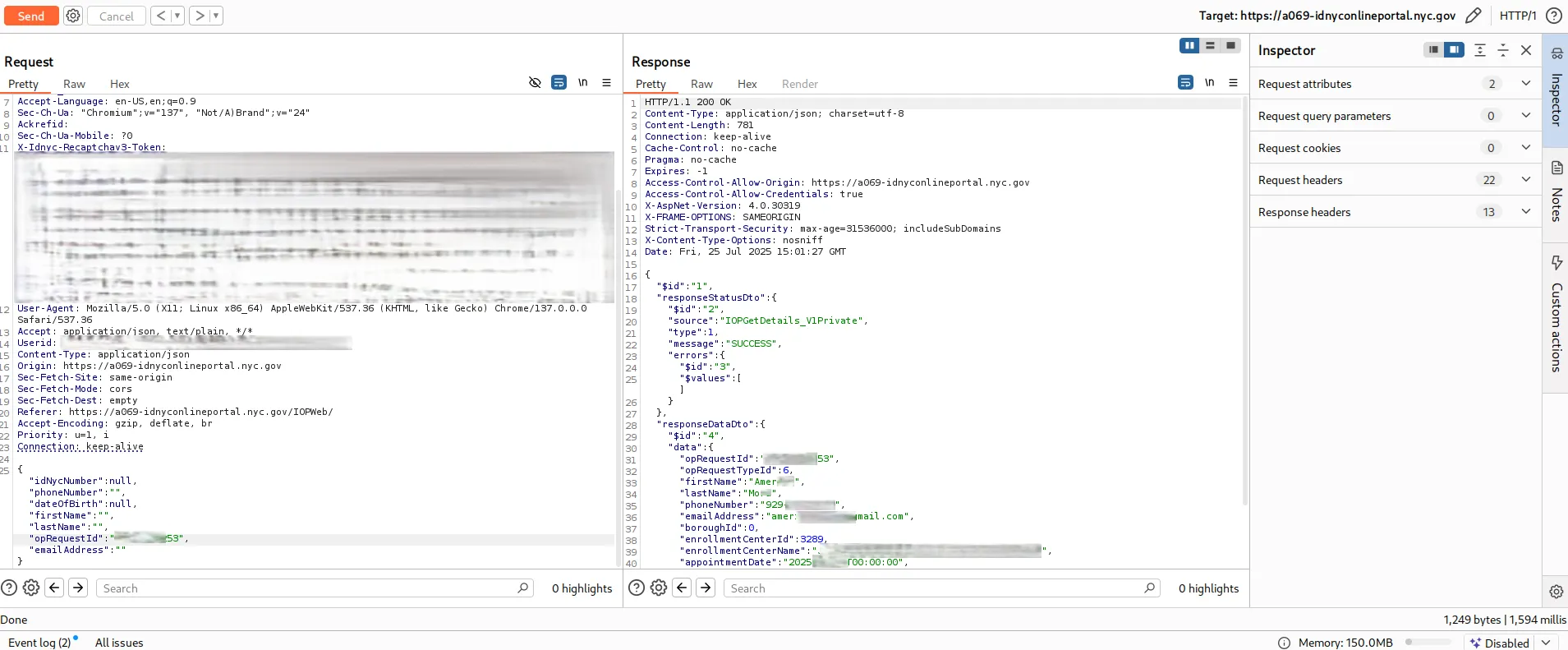
I observed that confirmation numbers appeared predictable (sequential/incrementing patterns), which significantly increases the risk of unauthorized access at scale.
Status: Fixed (the issue is no longer reproducible as of this post).
Fix implemented (what changed)
The responsible agency implemented an improved fix for this issue. Their solution reduces the amount of exposed data, which is a strong approach to mitigating this IDOR vulnerability. Based on what I observed during retesting, the fix appears effective and significantly limits unnecessary data disclosure.
This is a well-designed mitigation: minimizing returned data helps prevent unauthorized access to sensitive information even if an endpoint is misused.
Impact
If abused, this would allow an unauthorized party to access personally identifiable information (PII) associated with appointments, including:
- Full name
- Email address
- Phone number
- Appointment details (location, date, time)
This represents a serious privacy and safety concern because the confirmation number functioned as the only “key” to sensitive user records.
What I observed
After completing an appointment booking, the system displayed an 11-digit confirmation number. While testing with appointments I created using my own information, I noticed the numbers followed a predictable pattern (small changes between valid values).
In the “View / Reschedule / Cancel” flow, entering only the confirmation number was sufficient to reach a page that revealed appointment details and associated PII—without any additional verification step.
Validation steps (responsible)
For responsible disclosure reasons, I kept testing strictly limited to my own appointments and did not attempt to access or enumerate other users’ data.
High-level validation flow:
- Create an appointment and note the confirmation number.
- Create a second appointment and compare the confirmation number structure/pattern.
- Use the site’s “View / Reschedule / Cancel” feature and enter each confirmation number.
- Observe that sensitive information is displayed without authentication.
Any screenshots I captured were redacted/blurred to remove PII.
Evidence (redacted)
PoC screenshots (PII redacted):
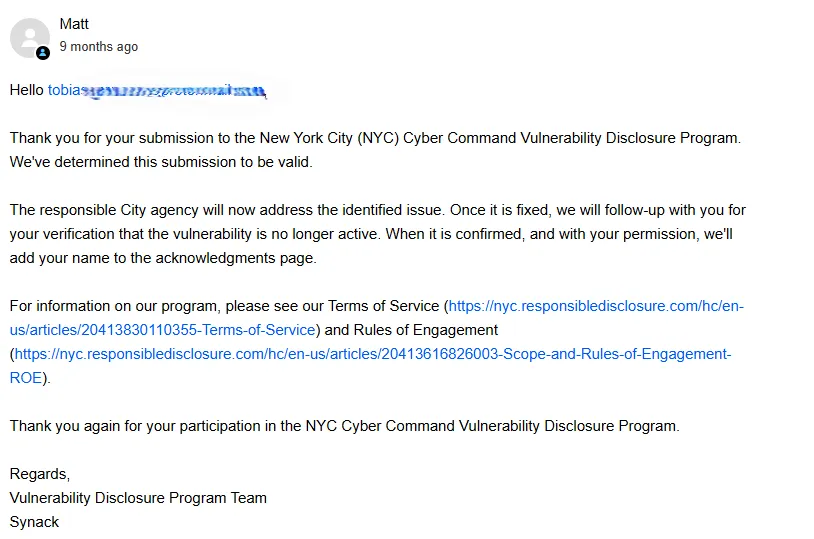
Acceptance / validation response:
Root cause (high-level)
The system relied on a single, user-controlled identifier (the confirmation number) as the only gate to an appointment object.
When an identifier is:
- the only requirement to access a record, and
- guessable / has low entropy,
it becomes an access-control problem, not just an “identifier” problem.
Recommendations
Defensive controls that typically prevent this class of issue:
- Require authentication for appointment management OR a secondary verification factor (email/SMS one-time link, last name + DOB, etc.).
- Use high-entropy, unguessable identifiers (random tokens) instead of predictable sequences.
- Add rate limiting, anomaly detection, and monitoring on lookup endpoints.
- Ensure server-side authorization checks enforce “user owns this appointment” before returning any PII.
Takeaway
This was a good reminder that access control must be enforced server-side and that “confirmation numbers” can quickly become security tokens if they unlock privileged actions.